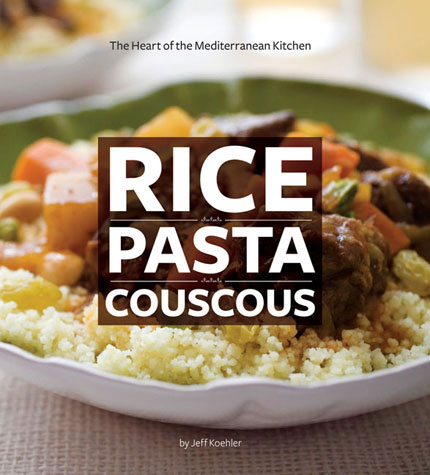
Rice, pasta, and couscous. All cultures feature some version of these starchy standards. I could make an argument that these foods are the backbone of a successful meal. But that argument would only be half the story behind Rice, Pasta, Couscous: The Heart of the Mediterranean Kitchen from Jeff Koehler and Chronicle Books.
Because I was drawn to this cookbook for other reasons; for starters, the author impressed me with his photography and writing skills as much as his inspired collection of recipes. This book has a very personal feel to it. Koehler’s descriptions of the recipes and his travels in researching this book give great insight into one of my favorite subjects, why we love the foods we love, both individually and culturally.
Though many areas of the globe feature versions of these staples, Koehler chooses to concentrate his focus on Mediterranean flavors and styles. Which seemed a warning sign to me that I’d likely find a collection of risotto recipes as familiar as a beloved old nonna.
 But this is way more than a collection of expected regional pasta recipes. The author has eaten with people all over the Mediterranean; he’s talked to them too. It’s apparent in the simple complexity and depth of nuance that separates his version of Rosemary Risotto from any of the other lovely preparations you may have enjoyed in the past. His recipe is infused with the earthy flavor of local whiskey. Replacing the “clean and tangy notes” of white wine with rustic tones more suited to rosemary. I almost made this dish for you today.
Because it is details like this that prove just how thoroughly Koehler dives into his subject; and it’s the stories and remembrances attached to these revelations that tell us he comes at his subject from more than just a cook’s perspective.
He offers us insight into the cultural significance of rice, pasta, and couscous. Proving, in culinary terms, just how diverse yet interconnected the food traditions of the Mediterranean really are. That’s because the area’s influences date back to the time when merchant’s vessels crisscrossed the great trade routes, a time when the sea became the vehicle that connected different cultures within a similar climate.
 There is enough information about these food traditions to take this work in a scholarly direction, and that would certainly be an interesting read. But Koehler takes a more personal approach. He has lived the Mediterranean life. He has immersed himself in Mediterranean foods, kitchens, and restaurants. Adding a strong sense of congenial authority to his work.
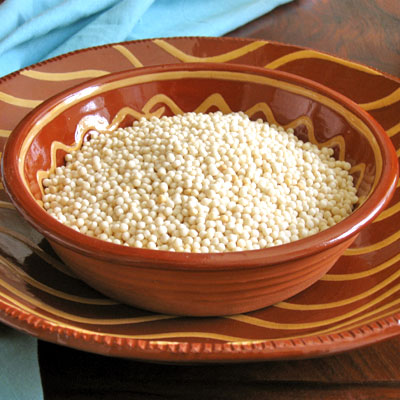
As much as I love whiskey, I chose to make a Sicilian Couscous with Fish Broth. The choice was a slam-dunk for me as I’ve been trying on my own to reproduce the very same dish that’s been buried in my memory banks for more than 20 years.
In fact, I predicted this recipe would make an appearance on this website back in Sep ’09. I was bringing you a simple Pesto Trapanese, recalling this exact couscous dish in the text of that post. But I never could lay my tongue on just what the distinctive spice flavoring defining this couscous could be.
Well, I now know, it a combination of cinnamon and bay leaf. Which when combined, is not at all cinnamony, nor as bitter as a big hit of bay leaf. I admit the combination stumped me all these years. I was reaching for saffron when I should have considered that there were, of course, more exotic notes that likely would have been traded along those ancient merchant routes I mentioned earlier. So it was cinnamon all along!
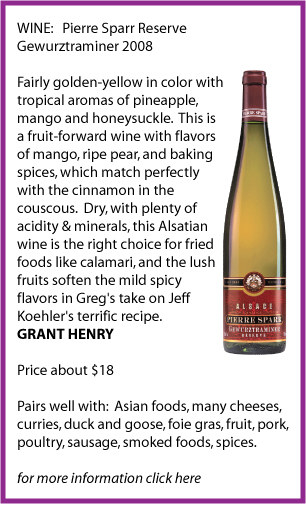
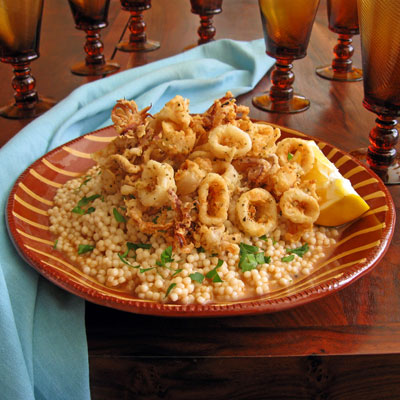
We also have a wine pairing for this very special dish. I asked my 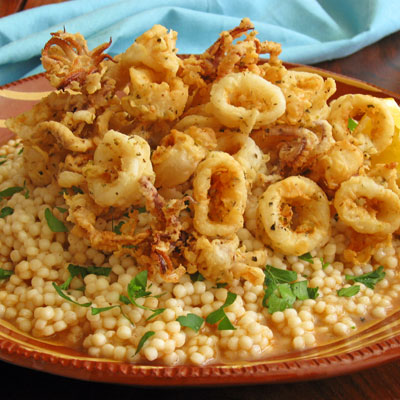 brother Sip! to come up with something special, even a bit unexpected. And unexpected is exactly where he went. Today we are pairing the complex cinnamon notes in this dish with a very un-Mediterranean Alsatian Gewurztraminer! Which is absolutely perfect with the handful of calamari fritti, simply floured and fried that Jeff suggested I serve with this couscous. Well, he didn’t suggest that to me personally, but this is the kind of cookbook that makes it feel as if he did.
I have also added this book to my OpenSky Shop. Click here to purchase the book.
Sicilian Couscous with Fish Broth and Fried Calamari
serves 4
CLICK here for a printable recipe
- 1 lb couscous (about 2 1/2 cups)
- 3 T extra-virgin olive oil
- 1 medium onion, finely chopped
- 2 clv garlic, peeled and minced
- peperoncino or red pepper flakes
- 4 plum tomatoes, peeled, seeded and finely chopped
- 1 stalk celery, finely chopped
- 2 1/2 pounds soup fish, such as scorpion fish, roosterfish, grouper, or other firm-fleshed white fish
- 2 T tomato concentrate
- 1 T flat-leaf parsley, roughly chopped
- 1 three-inch piece cinnamon stick
- 2 bay leaves
- salt and pepper to taste
- 7 c water
- 1 1/2 lb lightly floured and fried calamari rings (optional)
 Prepare the couscous according to the instructions on the package.
Meanwhile, in a large pot or Dutch oven over medium-low heat, heat the oil. Add the onions and cook it until it begins to soften, about 5 minutes. Add the garlic and some pinches of peperoncino and cook until the onion is translucent and the garlic is golden, about 5 minutes. Add the tomatoes and celery and cook, stirring frequently, until they are soft and mushy, about 20 minutes. Lay in the fish and stir to cover with the sauce. Add the tomato concentrate, parsley, cinnamon, and bay leaves and season with salt and pepper. Cover with water, bring to a boil, reduce the heat and simmer uncovered for 30 minutes.
Strain the stock through a sieve, pressing out all the juices. Discard the solids and transfer the broth to a clean sauce pan. There should be 4 or 5 cups of broth; stir in water if necessary. Taste for seasoning and adjust as needed. Cover and keep warm.
Place the couscous in a large, wide serving bowl. Pour 3 cups of the broth over it, stir with a fork, and cover tightly with aluminum foil. Wrap in a kitchen towel and let stand 30 minutes to 1 hour.
Just before serving, fluff the grains. Reheat the remaining broth and serve on the side. Top with the optional fried calamari if you like.
SERIOUS FUN FOOD
Greg Henry
SippitySup

‘Them’ being those crazies accusing folks of social agendas! Screw ’em. Just keep on braisin’ those taters!
Ha ha! I say stick it to da mahn (or Martha in this case) cause I’d rather read your blog and eat your food any day! Lunatic is as lunatic does and when I read your posts I get the feeling that you and I think quite a lot alike. So there! And these potatoes look fabulous!
So you heard my rumblings all the way down in SoCal — thanks for helping to address this shameful issue with a delicious sounding dish. Can’t wait to tuck in!
Looks great, but I have texture concerns. Still, I wouldn’t be surprised if you become a trend setter with this!
Please tell. I trust you. It was very soft and very typical of potatoes you might find in stew. GREG
The whole reason I read the blogs I do is the “voice” of the writer. If I just wanted recipes, I’d scroll through BigOven all day long. I want the banter, the witty barbs, and the personal tidbits.
And I appreciate the irony of you “giving the finger(ling)” with this post, nice touch.
These are not the droids you’re looking for.
So far all is quite on my blogs Western Front. GREG
You must get some interesting mail, they say the sign of a great blog is the amount of crazy lunatic comments you get, sounds like you get your fair share!
P.s. Love the recipe. We southern californians are weather challanged, it rains at least once a month 😉
… so you may have no idea about the rain. Sadly, once it starts it continues and continues in wave after wave. It seems we are starting a week of just such a pattern. GREG
Great post, even better dish. I love potatoes, I don’t know why I’ve never braised them on their own. Obviously I need to correct this. I feel I’ve been brainwashed by you into thinking this, but oh well there it is.
Brainwashing is proven technique in pushing my social agenda… GREG
Sorry, I didn’t mean for my stomach to grumble so loud. I tried to shush it to the best of my abilities but yet it wanted to be heard. I think some of these braised potatoes would shut it up. ;-D
It’s ‘cuz you live so close that I can hear your tummy so well. GREG
All that it was missing were the veiled commentaries on your social agenda that I’ve come to love. Greg, you can’t please everyone. You please me though! Thanks for everything. I love recipes like this. So matter of fact that I’m surprised Ms. Stewart would touch it. Have you seen her agenda? That lady is BUSY!
veiled social commentary is the point of a food blog now isn’t it? GREG
Your humor/tone in this entry is fantastic. It definitely kept me reading until the end. And, well, there was a fingerling recipe to get to. That helped too! Fingerlings have quickly become one of my favorite potatoes. I will have to try this recipe soon!
I love what you are doing at your blog these days. GREG
…I’ve heard of people being driven to drink, but being driven to braise potatoes, well that’s a new one (even for me) — still, if the end result is half as tasty as it looks and sounds, then it’s a case of all’s well that ends well, at least for your potato lovin’, weather challenged Sippity Sup readers! 🙂
Thanks for not hating me for putting you (of all people) through that. GREG