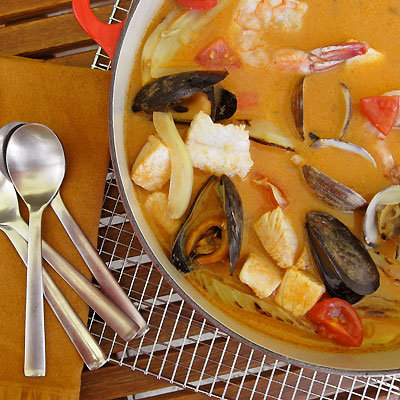
We call it rustic Italian fish soup, but if you speak Italian you probably realize that brodetto is a word that means more than one thing. To those in Florence brodetto is an eggy bread soup with lots of lemon served at Easter. However in towns closer to the Adriatic brodetto is a hearty kind of fish stew similar to what we might call cioppino, or what the Tuscans might refer to as cacciucco.
Why the confusion? Well, until modern times very few Italians spoke “Italian”! There were regional dialects and most people were more comfortable speaking the language of their families.
But all this does not explain why I had a bit of trouble finding a recipe for the traditional Italian fish soup I know as brodetto, and the point of this story. You see, it all started in Palm Springs last weekend. I know, I know– Palm Springs and Italian fish soup is a stretch, but let me explain. You see I discovered in Palm Springs that Marcalla Hazan has a wonderful version of brodetto in one of her cookbooks. I happened to flip through a copy while at a friend’s house there.
After glancing at that recipe (I saw pureed fish heads and I was sold) I knew I was destined to come home and research this soup. It’s what I do when I get food obsessed. But in this instance, I should have borrowed the book. Because when I got home I scoured the internet and my vast collection of cookbooks seeking out a version of her recipe or at least something similar enough. It was a no go! I came up empty handed. Partly because brodetto could be so many things, local ingredients seem to be the ties that bind the dish to the name. Those ingredients do not even have to be fish!
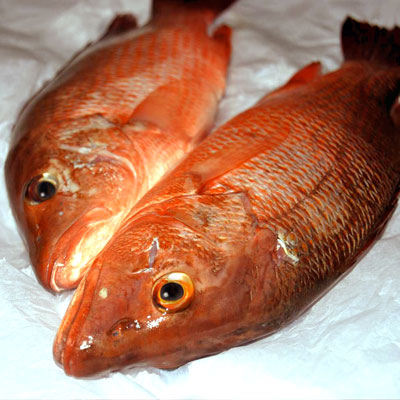 Sure there were all kinds of Italian fish soups and fish stews, by many different names. But most seemed geared to finicky modern eaters who go queasy at the idea of fish parts that are not neat and boneless. Still, why would there not be countless versions of this classic fish dish plastered all over the Internet?
Brodetto
Well, the rather simple answer is that to the Italians of a certain (long past) generation, brodetto is considered poor people’s food. The wives of the men who caught the fish typically made it with the leftover fish of little market value, and seemingly every wife had her own version. So as Italy’s modern food traditions were developing in the 19th century, the middle class audience that become the consumers of the Italian cookbook sorta snubbed brodetto and the name fell out of fashion. Be it fish based or bread based…
Times have changed, however, and now modern Italians who live along the Riviera Romagnola (the Adriatic coast north and south of Rimini) are rediscovering this dish. Not that this makes finding a true brodetto any easier, because true brodetto is shockingly simple, and restaurant cooks (and many home cooks) find the temptation to jazz it up irresistible. Myself included!!
Which is why I was so drawn to the rustic charms of Ms. Hazan’s version. But alas, I do not have that version or that book in my possession. So I am forced to reach back and follow the traditions of 17th and 18th century fishermen’s wives and make my own version.
I did find an interesting set of brodetto guidelines. I followed as many as I could. But ultimately I used Ms. Hazan’s directions (or at least my memory of them) in developing this version, which can be seen in the recipe section by following the links below.
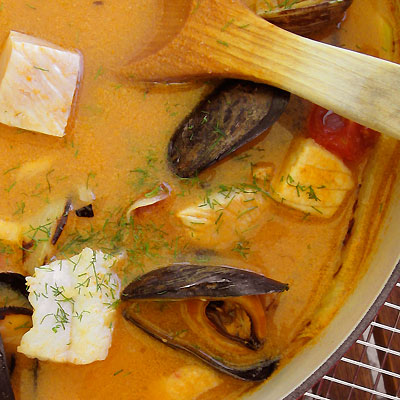 Brodetto serves 6 CLICK here for a printable recipe
The Basics of Brodetto from Kyle Phillips
Simply put, the first rule for making brodetto is that the fish must be absolutely fresh. Small, spiny, ugly, doesn’t matter — it has to be flavorful and fresh. Thawed won’t work, nor will something taken off the boat yesterday morning.
The second rule is that the fish should be local; the fish that go into brodetto vary from town to town along the Riviera Romagnola, but include (among others): Cuttlefish, gray mullet, reef mullet, mackerel, bogue, striped mullet, mantis shrimp (when in season, and some purists shudder at them), crabs, and sole. If possible the fish should be washed in seawater, but you should only do this if you know your water is clean.
Mussels and clams can go into a brodetto, but often do not (family members not on the boats or selling the fish used to gather clams on the beaches to make clam stew), while scampi and other more prized crustaceans would never have gone into a traditional brodetto — they’d have been sold. Likewise, a traditional brodetto would not have contained anything exotic, or that had to be shipped in. One thing the fishing families did do to increase the flavor of their brodetto was to gather the heads of the fish they sold, boil them separately, and add the resulting rich broth to the brodetto pot.
Spicing and seasoning? It varied from town to town, but was simple, as the fishing families had to barter with farmers for herbs: Olive oil was a constant, and one could also find onions, fennel, garlic, parsley, vinegar (often substituted for by dry white wine), a little salt, and abundant freshly ground pepper. Tomato paste and tomato sauce (used sparingly) didn’t appear until the mid-late 1800s, and the use of hot pepper is even more recent.
Cooking vessels and times? Tradition dictates one use a low-sided broad round terracotta pot, and a gentle flame; Metal will of course also work, but will transmit the heat faster. As is the case with all mixed fish stews one adds the fish to the pot in succession, first the kinds that cook slowly and the larger pieces, and then smaller pieces and quickly cooking fish. Total cooking time will be a half hour or more.
Finally, serving: Romagnoli generally serve brodetto over slices of toasted bread that do a beautiful job of soaking up the drippings, and accompany it with Sangiovese di Romagna, a light lively red wine. The other option I might consider for a wine would be Trebbiano di Romagna, which is just as light and lively.
SERIOUS FUN FOOD
Greg Henry
Sippity Sup
Brodetto
So glad you finally took the cong you bing plunge! Aren’t they addicting? They are the first thing I made after I had our 2nd daughter. I just HAD to have them.
I have always wanted to make scallion pancakes, but never got around to it. You make it look and sound so easy (& delicious!) Great photos!
Love the photos. I actually made this a week ago but I tried it with a thinner batter. The thicker dough that you roll flat is definitely something I have to try.
I LOVE the Korean version of these and was hoping you would say they are similar. I am bookmarking it to make myself. YUM! Thanks for sharing.…
Your recipe certainly makes it look easy enough, but then again you cook with such ease! I will have to give this a try (and I must say, I love the perfectly toasted portions on these pancakes!)
ohhh this is one creative theme, I love it! those scallion pancakes would make a great appetizer to serve at a dinner party!
Love scallion pancake. I always make them from leftover dough when making dumplings.
I like the name of your blog a lot! Any experience of Swedish pancakes? I’m making Swedish Crepes in the next episode of my online cooking show, please check it out!
Aw I should try these someday. We don’t have any quality Chinese food here so if you want something Chinese, the only solution is to make it yourself. I don’t know if sesame oil is sold here (I’ll have to check) — do you think walnut oil would work…erm? :-/
has a very distinct flavor, if you can’t get it choose an oil with a slightly nutty but mild flavor like walnut.
I love the weekly themes you come up with now and again, very creative, and a way to force yourself to pick-up some new recipes along the way. I mean, how many pancake recipes can one guy have anyway? These look great, and the kids would love them. We’ll have to give them a try. Cheers — S
Great pancakes Greg. These scallion pancakes are my favorite. I’m a savory kind of person.
Sam
I love scallion pancakes, even tried my hand at making some not too long ago. But your photos really take my breath away, wow.
Just wondering, once you oiled and rolled the dough, did you have a problem flattening it out? The oil just got in the way of everything for me, making the flour clump on the rolling pin. Any word of advice?
If you are talking about the oil in the dough, I had no problems. But if you mean t sesame oil I brushed on right before adding the scallions then I would say that the first couple were a problem. But I got the hang of it. In the end I used very little sesame oil. Just enough to get the scallions glued down. GREG
Think i’m slobbering too much oil on it. I’ll be sure to try it out again, thanks!
Soooo good. Interesting fact about the rolling. I have spent some time in Kenya, and after coming home I really missed chapati. Luckily I have a Kenyan friend here in the states. She told me to make my chapati exactly like this (well ‚diff ingredients) — same rolling/coil, sitting, kneading.
Thank you for this recipe and step by step!
I love these pancakes and order them every time I have Dim Sum.
I make congee at home all the time — just finished a pot of fish congee yesterday
You really must give it a try — it’s so easy, and can simmer away as you make scallion pancakes to go with it!
Dim sum nice looking pancakes, Greg! (Will the pun ever stop?)
Ok, seriously this time. I have been wanting to try these ever since Jaden did them on Steamy Kitchen last year. I’ve never actually had them but when I see them here it just reminds me of how I MUST try these soon. I didn’t realize they were actually breakfast/brunch. Can you still do them as an appetizer for a Chinese themed dinner? (Not that I’d let it stop me if it isn’t okay!)
When I lived in NY and worked for a Wall Street firm that entertained clients over lunch prepared by our Chinese Chef in a private dining room, I got to eat scallion cakes frequently. I’d almost forgotten about them. Yours look perfect. I’ve never had it with the dipping sauce, but it sounds good.
… a nice memory! GREG
Easy easy. Looks like at home dim sum can be had any day!
I’ve actually never had or made these, need to try soon for sure!
my one try at making these was a total fail, this makes me want to try again!
These are my favourite. I like to make them. It’s fun to make and eat. Usually I make some into pancakes for aromatic crispy duck and some into these scallion pancakes and also some into egg rolls pancakes. Really delicious with dips.
it’s been awhile since i’ve been to a chinese restaurant that offers these scallion pancakes. they are a great appetizer! i like your dipping sauce with the red chilies in them. reminds me so much of how my mom always cuts up thai chilies and puts it in her fish or soy sauce for dipping with meals!
Love this series of posts — IHOP and this one really drew me in. Cannot wait to give it a try.
By the way, pa jun has egg in it. That’s the difference, similar to the difference between ravioli wrappers and won ton wrappers. The ones with egg are more elastic and heavier.
It’s so appropriate that you knew the answer to that! GREG
How you manage to churn out such high quality posts on such a frequent basis is incredible to me. My day job has been so crazy lately that I’ve not posted in weeks. 🙁
Luckily, I can live vicariously through GREG! 🙂 Love this pancake series. Love these scallion pancakes. Love your writing. xo