Okay, okay, okay. Okay, okay.
I get it! Some people are afraid to cook fish at home. But I can’t really figure out why. My friend Dash of Stash who is an excellent cook even admitted some trepidation recently. In fact he and I have made a deal. I’ll cook ribs on the ‘cue if he’ll cook something from the sea. So I have compiled some information to help him (and you) along that road.
Statistics show that people like to eat fish. Americans are now eating 30 lbs of fish (per person on average) a year in restaurants, but they eat half that amount at home. And of the home-consumed fish, half of that is canned tuna fish.
Now, unless my math skills fail me, that means people eat more than 3 times as much fish in restaurants than they do at home (if you exclude all that canned fish). It’s like 10th grade PSAT’s!

 And as everyone knows, fish is good for you– and the crazy thing is fatty fish (salmon, tuna, mackerel) is REALLY good for you. How often is that gonna happen in your life. They are never gonna say “cupcakes are good for you and fatty cupcakes are really good for you”. So take your fat where you can get it! And trust me (Stash) you can get it at home…
So, where does the fear come from? Choosing fish? Why do most of us have no trouble picking out a fine, juicy steak at the market, but a flounder fillet leaves us (well, you know) floundering.
Buying fish is no more a mystery than buying fresh veggies– that’s because the key to both is buying fresh. The signs of fresh fish are these:
—Bright clear eyes. If it looks dead, it’s probably past perfection.
 —A firm, springy flesh. If you press your thumb into the meat it should bounce back with almost no perceptible indentation.
—-When the fish or fillet has skin on it, then the skin should be bright and shiny. Almost metallic. Dull or splotchy is usually a bad sign.
—The liquid given off from the fish should be clear and clean. If it looks cloudy or milky– back off.
—If it’s a whole fish, check out the gills. They should be a rich red. If the fish is old, they will turn brownish or brick colored.
—Should you be choosing fillets, then your best indication may be smell. Fresh fish smell sweet and clean. Like the ocean on a cool, bright day! Not like the scummy fish tank your college dorm-mate down the hall kept during your first semester of college…or was that just my crazy dorm-mate? Either way, fresh fish does not smell fishy!
—But the best way to buy fresh fish is from someone or someplace you trust. Build a good relationship with the people at your market. Ask questions. Most people are proud to pass along the special knowledge or skills they have learned on the job. Ask smart, respectful questions and your fishmonger or grocery clerk will remember you. Then next time you’re in, it’s very likely that they will point you in the direction of something particularly good, fresh and yummy!
Now that wasn’t so hard. You can’t still be afraid– so put down the tuna can, and start paying attention. I can help you!
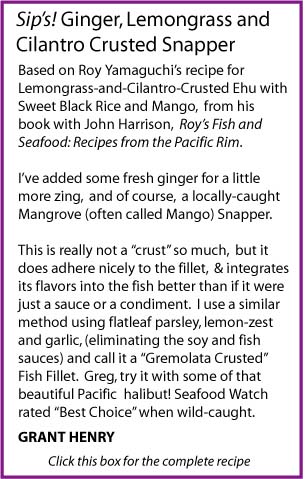
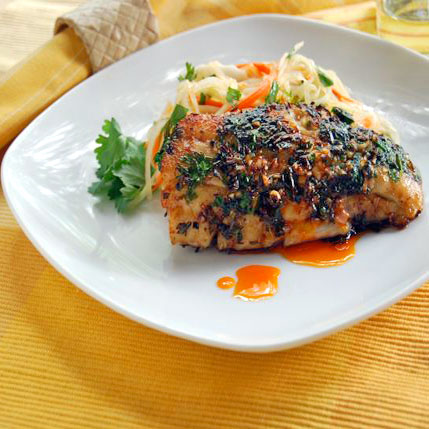
In fact I am in Florida right now. My brother Grant is going to cook fish for us. I may have some general tips and instructions but he has a culinary degree! He will be making a beautiful Ginger, Lemongrass & Cilantro Crusted Snapper. There is more about the specifics of that in the box above.
Now, in general terms once you have chosen good fish how do you cook it? Well I hate to be a smart-ass, but in truth it’s no more difficult than cooking potatoes. I’m serious. You can fry, bake, boil, broil or saute. Really it’s that simple.
The only fork in the road is choosing which form of these great cooking styles is most suited to your “catch”.
I have some very general guidlines I follow. But a lot of this is just to your your own taste. If you like fried fish then you’ll like fried salmon as well as fried haddock. Heck you might even like fried boot leather if I told you Mario Batali cooked it (oops, did I say that out-loud?)
Anyway, same goes for baking, broiling, boiling and sauteing.
But the qualities of certain fish make it easier to cook to “a just done perfection” by one method over another.
Overcooked fish is a waste of the poor creature’s life. I’ll say it again. Overcooked fish is a waste of the poor creature’s life. One more time?
I get sad when I see a gorgeous fillet of salmon cooked so far past done that it’s hard to imagine what it once was. Salmon should be rare. It just should. But it’s a fatty fish and somewhat forgiving– so many people overcook it with out ever realizing what they have done.
On the other hand, swordfish left too rare does not bring out its best qualities. However, overcooked swordfish is dry and nearly inedible. Achieving that perfect state of doneness can be more easily accomplished by wisely choosing a cooking method.
Rather than make a list of every fish we can think of and try to suggest a perfect cooking method let’s break things down to 3 categories.
Not-Fatty Fish typically have less than a 2% fat content. BLACK SEA BASS, BROOK TROUT, COD, FLOUNDER, HADDOCK, HAKE, HALIBUT, MONKFISH, ORANGE ROUGHY, POLLOCK, PERCH, SNAPPER, ROCKFISH, SOLE, TILAPIA, TILEFISH and TURBOT. These fish are often cooked by poaching, steaming and pan-frying. It’s a bit harder to dry these fish out through overcooking because they benefit from a wet cooking method. But that can’t stop you from actually overcooking them, which really ruins their texture. This kind of fish also tends to flake and fall apart when cooked. This also limits the manner of cooking somewhat. Deep-frying can be a good method, but it’s quite easy to overcook fried Not-Fatty Fish. So watch it closely.
Sorta-Fatty Fish typically have between 2% and 6% fat content. BARRACUDA, BLUEFISH, BONITO, CATFISH, POMPANO, RAINBOW TROUT, STRIPED BASS, SWORDFISH, WHITING. I think pan-frying is best for these, because these are the fish that can easily dry out if overcooked. So they need attention. These fish may also be baked, broiled, roasted or grilled, but again– give them some attention because it’s even easier to overcook them this way.
High-Fatty Fish typically have between 6% and 12% fat content. But the Herring has a whopping 18 % and it’s good fat! others are: ALBACORE TUNA, BUTTERFISH, GROUPER, HERRING, LAKE TROUT, MACKEREL, SALMON, SMELT, STURGEON, YELLOWTAIL TUNA. Grilling works well with higher-fat fish, because they have a rich flavor, and the smoky quality of the grill lends itself to this. Plus they are often meatier than lower-fat fish. But pan frying, roasting, and baking is also very, very good. But my favorite way is it to slow-cook these High-Fatty Fish. I put them into a 225-degree oven for about 18 mins for 1 1/2 thick fillets. Then I turn the oven off and leave them in there a couple of hours with out opening the door. The texture is incredible. I can’t explain what happens, because not only am I not a chef–I am not a scientist either. But what a transformation it is! Still, don’t be squeamish about leaving the fish out so long either, you know that just makes Sup! mad. So trust me and try it!
Of course, use fish from a trust worthy source– and don’t sue me if you get sick. My team of lawyers made me say that, I don’t really believe you will have a problem.
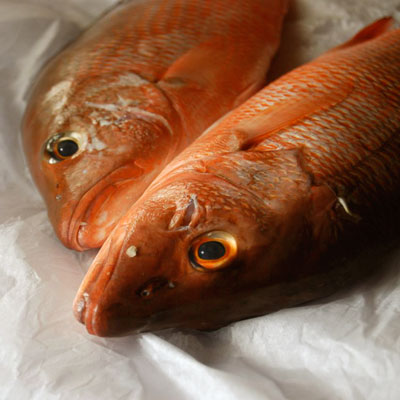
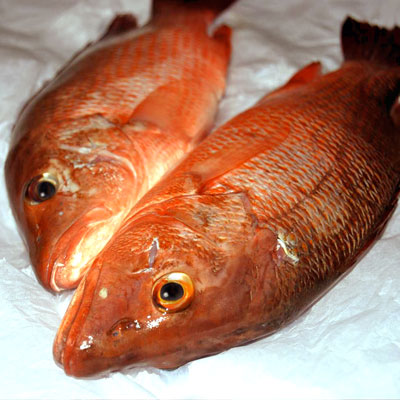
 Grant is going to use the snappers we got super fresh and straight from the source. These snappers were line caught as is plain to see in the photo and a good sustainable choice. Especially when you are in Florida. Because this is a common snapper in Florida. Sometimes it is sold as Mango Snapper, but anyone with a dock in Florida proably calls it a Mangrove Snapper. I am pretty sure they are exactly the same thing. Oh those High Faluttin’ Floridians.
SERIOUS FUN FOOD
Greg Henry
SippitySup
Very informative! Preparing fish is a difficult thing. It’s nice to read an article by someone who knows what they’re talking about!
I do not have to repeat myself on my love of these beauties…oh my lovely tomatoes, how I want to grasp you in my hands, and feel your flesh give way to my biting, nibbling ways…okay, sorry for the overkill, but you did present such a fantastic sexy dish here!
My friend brought me some heirloom tomatoes and basil from her farm share yesterday so we also had a simple tomato & basil salad, yummy!
I am so jealous of your heirloom tomatoes. The selection around me is so-so and very expensive.
The colors are just great and the basil leaves are perfect too!
Just how many tomatoes are in a pornographic pile of tomatoes? Just so I know for future…
By the way, this is gorgeous, and I could eat the whole thing.
Great photos! The low contrast makes the color of the tomatoes really pop.
This salad looks so beautiful with all the colors. Makes me want to go out right now and buy some heirloom tomatoes!
Your photos just sprinkled a rainbow of colors across my otherwise foggy day—such alluring captures of a delightful recipe.
I love all the colors in the dish. Simple, yet so delicious. I would be happy with that as a meal alone.