I know you know you know this. But there is more than one kind of basil in this world.
So it makes sense that certain varieties might suit themselves better in certain situations or flavor combinations.
Sweet basil (Ocimum basilicum) is by far the most common variety. It is widely recognized as the standard, especially in Italian cooking. It’s big, bold and flavorful. Well deserving of all the attention it receives.
But genius sometime lies in the details. And I know you want to be a genius, right? I mean “always aim for the left field bleachers” I always say. Actually I never say that. I hate baseball metaphors. But I am being editorially lazy and relying on standard catch-phrases. Shame on me!
Anyway, lose the lazy and familiarize yourself with other varieties of basil as well. We may be talking nuance here, and subtlety is not an attribute commonly attached to basil. But nonetheless there are subtle differences between the varieties. Some of these Ocimum cousins have gotten themselves entrenched in cuisines the entire world over. So we may need to take a vitual world tour to learn all we need to know.

 That is because basil is a member of the mint family. So they are a hardy, easy to grow plant. There is one suited to most any environment.
That may account for its success in so many cultures. We know and love basil in Italian cooking. But it is a very common ingredient in Asian cooking too. Particularly Thai. In fact there is even a variety known as Thai basil.
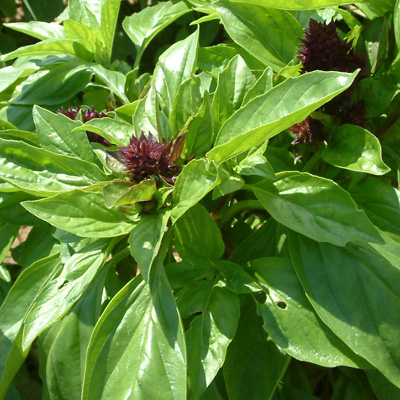
I think Thai basil is a very good place to start when experimenting with new basil flavors. It has a more assertive taste than the sweet basil you are used to. Though it certainly tastes familiar. You will know what you are eating, but it does have the loveliest hint of anise to it as well.
Thai basil has become rather easy to find. Most cities have a good Asian market or two. So start there. But Farmers Markets are plentiful these days. Mine even sells seedlings which I buy and grow at home.
That’s because it is quite a pretty plant too. It’s got thicker, pointier leaves than your sweet basil. The stems can have a purplish cast to them too. They flower very freely and the flowers taste every bit as good as the leaves. In fact I often wait until buds develop before I harvest. The flowers are reddish-purple as well. Which looks nice in my garden so I grow it as much for it’s ornamental value as I do its culinary power.
As its name suggests Thai basil is used in Thai cooking. There are three types of basil typically labeled Thai basil. I grow and use the most common variety, which is known as bai horapa. There is also a Thai basil known as bai gka-prow, or sometimes holy basil. You will detect hints of clove in its flavor. The Hindus consider a plant called holy basil sacred. But I think it is another plant entirely.
Lastly there is Thai lemon basil. Which I have never tasted and can’t say much about.
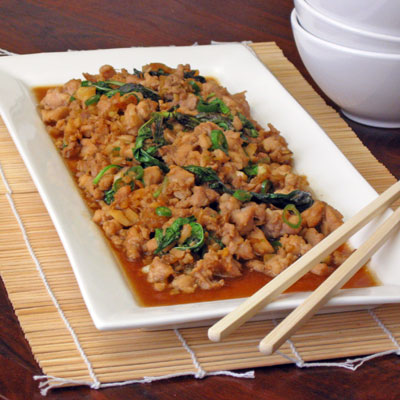
But I can say Thai basil is common in many styles of Asian cooking. But as it is named Thai basil it makes sense to start in Thailand. So, I am going to make a classic Thai dish. Its one of the most common and beloved dishes of Thai family-style dining. Gkai Pad Gka-prow. Which is Spicy Thai Basil Chicken. But it can be made out of anything, people often substitute the chicken with pork, beef, squid, shrimp, and seafood, anything they like. There is a clam version I order at a local Thai restaurant here sometimes.
I am going to use boneless chicken thighs. Dark meat is far more flavorful than white meat chicken. So I look for any good excuse to use it.
In Thailand this would be served over rice as an all-in-one-bowl-meal. Typically breakfast or lunch. It is quite common to see it served with a crispy fried-egg on top. But it also makes appearances as one of many dishes in a large family-style meal.
If you are not able to find fresh holy basil (bai gka-prow, which is standard), this recipe can be substituted with any fresh basil (even sweet basil). I am using Thai basil (bai horapa). I have also tried it with a mixture of fresh Thai basil (bai horapa) and fresh mint leaves with good results also.
The chicken pieces need to be quite small. It is the only tricky part of this recipe. Because the greater the surface area to coat with the flavors of the aromatic herbs and delicious sauce, then the more intense the stir-fry will be.
Don’t be afraid to make this quite spicy. The spiciness is used to help preserve the meat in the rural areas of Thailand. I realize you may have a fridge and that this may not be a problem in your house. But it’s part of how the dish developed and I think you should honor its roots. Because in Thailand this meal might be prepared early in the morning and served throughout the day as busy family members come and go.
However in my house it seems to go from wok to belly in about 6 and half minutes.
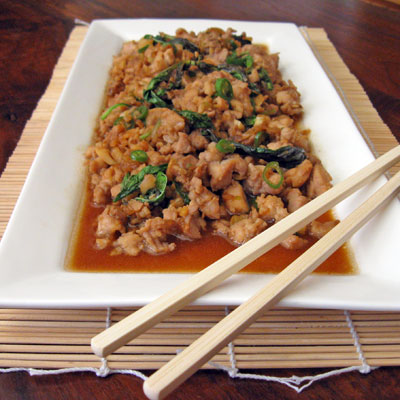
Serves 6
- 3 tablespoons canola oil for stir-frying
- 15 cloves garlic, roughly chopped
- 3 shallots, thinly sliced
- 1 lb. boneless chicken thighs cut into small 1‑inch chunks
- 12 Thai chilies (prik kee noo) cut into very thin rounds
- 2 small kaffir lime leaves (bai ma-gkrood), cut in chiffonades
- 3 tsp. black soy sauce (semi-sweet see-yew dahm wahn
- 2 Tbs. fish sauce (nam bplah)
- 2 cups fresh Thai basil (stems, leaves and flower buds)
- Pinch of red pepper
- More fish sauce and Thai chilies for garnish
- Lime wedges
Start by putting the chunks of chicken into the food processor. Pulse the meat 8 or 9 times. Do not turn the meat into a paste. You want something a bit chunkier than ground meat. This will make for plenty of meat surface to come in contact with the flavorful sauce.
Heat a wok or very large skillet until its surface is almost smoking hot. Swirl in the oil to coat the wok surface. It should “dance†and shimmer a bit if the pan is properly heated. Stir in the garlic and shallots. Stir continuously to keep them from burning. Though it is fine if they color some.
Almost immediately add the chicken. Stir-fry the mixture 1 to 2 minutes. When the chicken begins to change color but has not cooked all the way through yet toss in the chilies and kaffir lime leaves. Sprinkle black soy sauce over the mixture and stir-fry for another 30 seconds. Season to taste with fish sauce.
Once the chicken has cooked through stir in the fresh basil and toss well. Stir-fry another minute or so, until the basil is wilted. Sprinkle with red pepper and transfer to a serving dish.
Serve with plain steamed rice and a small bowl of fish sauce with some chilie slices floating in it and some lime wedges on the side.
Note: If you cannot find semi-sweet black soy sauce use regular soy sauce and a tablespoon of brown sugar.
SERIOUS FUN FOOD
Greg Henry
SippitySup
You can’t say too many times. Don’t OVERCOOK the scallops. Gordon Ramsey’s been known to spit in a cook’s face for such a thing.
Why don’t I remember to eat more fennel, a perfect side for such delicious RARE scallops.
And now, the math question..