How many times has this happened to you?
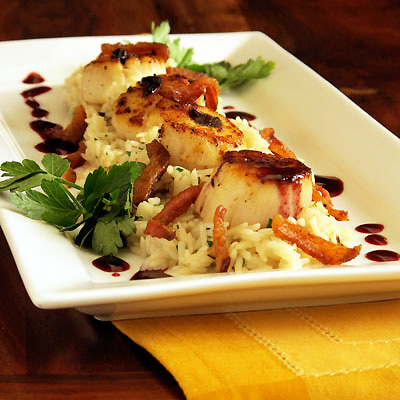
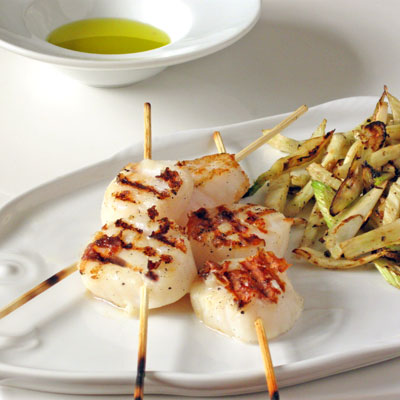
You are leafing through a magazine or cookbook, or maybe you are cruising through a few good food blogs. You come across a gorgeous photo of thick meaty scallops. They are seared to a crispy golden brown. But you just know they are sweet and juicy on the inside. They are oh so simply presented, sitting beside some lovely veggies or atop a creamy plate of risotto.
You actually salivate. You scan the recipe. Butter, oil, all the usual suspects. Okay, you decide, “I can do this”. You are a good cook. You know you are.
You know to use a straight-sided sauté pan. Not a sloped style fry pan. You are not stupid. You know the pan can’t be too big because you want to radiate some heat. But you are savvy enough not to crowd them into a small pan either. Who wants steamed scallops. You weren’t born yesterday.
You rush to the store. Oh look, a big bag a frozen scallops is on sale at Costco. You do not really need 10 pounds. But hey, they are frozen. They’ll keep right?
But like I said you are a good cook and you have noticed that those big frozen scallops tend to disappoint you for some reason. You can’t put your finger on it. But sometimes the sweet, full fresh taste of the sea is abridged by a faintly metallic taste.
You drop the bag back into the freezer case and head for the fish counter. No, this time you are not going to be taken in by the price.
This time you are splurging on fresh. The recipe seems to deserve it. Besides, cooking scallops is practically simplistic. It’s like a filet mignon. You put it in a hot pan and cook to just past rare. Who can’t do that?
You get to the counter to look for some help. How come there is never the same guy working here twice? They certainly do have a heck of a rotation of knowledgeable fishmongers at this place, you convince yourself.
But none of that matters because there they are; the scallops of your dreams. Nearly as big as a fist, and oh so heavy. Juicy too! They are practically weeping with moisture. Now you are weeping. The lady next to you starts to cry. It’s time to focus…
These are the ones. Sure they cost an arm and a leg. But how much can a dozen really cost you anyway. Oh! $25.00. Really… “Ah, screw it. It’s only money” you decide. You grunt and throw a dozen over your shoulder and lug them home with you.
When you spend this kind of money on a first course you want it to be good. So you take your time with the mis en place. You get everything just so.
You melt the butter in some canola oil. When it’s good and hot you gently slide those babies into the pan. You know to let them be. You resist the urge to move them about the pan a lot. Too much love and you won’t get that gorgeous golden brown color you saw in the photos. They will release themselves from the pan when they are good and ready. This much you know.
So you stand there and wait. Clicking your tongs to that old Madonna tune you have going on in your mind “…Borderline, feels like I'm going to lose my mind…Borderline”.
But you make it the entire 5 minutes without disturbing them. You start to flip those sweethearts over.
First thing you notice is how much moisture these guys gave up in cooking. I mean you appreciate the facial and all. But these scallops are half the size they started. Maybe you should have gotten 16 of them. You silently hope there are enough for everyone.
And another thing. Where is that golden brown color you envied in the photos?? Yours are a creamy translucent milky color of white. They smell done. The recipe clearly says: 5 minutes undisturbed on one side and 30-45 seconds on the other side.
Maybe it’s a typo.
Maybe your pan was not hot enough.
You turn the heat up and that’s when it happens. You make your fatal error.
“I’ll cook them a couple more minutes and then they will be that perfect golden hue I was promised”.
Sound Buzzer. End Of Game.
You have blown it. Your scallops are going to be over-cooked and rubbery. In trying to achieve that perfect crackly golden exterior, you over-cooked your $22.50 a pound monsters. You wanted crisp on the outside, but succulent in the inside. But it’s too late. I am sorry. They are ruined.
Like I said you ARE a good cook. This problem would happen to any one of us because it is not your fault! In fact it's a conspiracy. I know because little green men in Roswell, New Mexico told me so!
There is a dirty little secret out there in seafood land. It’s called STP. It’s not motor oil. But to a connoisseur it’s nearly as bad. Sodium tripolyphosphate.
It’s the bugger responsible for that metallic taste and it’s what keeps your scallops from browning up properly
As far as I can tell, the additive was originally designed to get scallops to absorb water. It keeps frozen scallops from drying out during the freezing and thawing process. It is routinely added to scallops frozen at sea.
But nowadays STP is often added to non-frozen scallops, prior to soaking them in water, as a way of causing them to absorb the water and increase their weight.
There is always a boogeyman and money is the root of all evil.
As you probably figured the supplier charges by the pound. The now water-laden scallop is considerably heavier. There are now far fewer scallops per pound. The supplier is happy but the cook is devastated.
As necessary as phosphates are with seafood frozen at sea. These same phosphates are easily abused. If a little STP can keep the natural moisture in seafood, imagine what a lot can do. Well you don’t have to imagine because I’ll tell you. It can cause a scallop to soak up so much water that it can increase in weight up to 25 percent.
And if that is not bad enough then look in your pan. There is so much excess moisture your results are steamed, rubbery scallops that will not brown properly not matter how high the heat or how long they stay in the pan, under the broiler, or on the grill.
So give yourself a break. The familiar tale I cited here is REALLY not your fault.
So now not only do we have to consider how sustainable our seafood harvesting practices are, and weigh the benefits of fresh or frozen, wild-caught or farmed. We have to wonder if our scallops are wet or dry.
Which is not the same as “dried”. It’s far more complicated.
Wet scallops are the ones treated with STP. The STP gives scallops a longer shelf life; they don’t dry out or lose their plump appearance. I live on the west coast. Very, very good scallops are not in our back yard. I went a lot of years eating the wet scallops because they are very prevalent here.
Non-treated dry scallops are harder to come by (for me...). So you have to ask questions. You even have to educate the people at some fish counters. Some of them will give you attitude about it. Shop elsewhere.
Good fishmongers will know the difference or will at least be open to hearing the information.
It’s your money. They are your scallops. It’s your right to know what you are paying for. Because STP or no, very good scallops can be in excess of $20.00 a pound (in my neck of the woods).
The ball’s in your court…If you want to see what I did (once I got some dry scallops). Click on any photo for the recipe: Seared Scallops with Pea Tendrils and Sichuan Peppercorns.
SERIOUS FUN FOOD
Greg Henry
SippitySup


Comments
wet scallops
I work and live among the New Bedford fishing fleet the largest scallop fleet in the world. The North Atlantic Sea Scallop is a true jewel of the sea, it has a firm texture and no matter how you cook it is succulent and sweet as can be.
The sad thing is we here in the city of scallops have a hard time finding "dry" scallops as well. It is so profitable for the processors to soak the scallops that a tiny percentage of dry scallops ever make it to the consumers plate. This is very sad when you consider the fisherman that risk there lives to harvest this product. If you ever have the opportunity to have fresh dry New Bedford sea scallops you would never eat a frozen STP destroyed scallop again. Honestly save your money, the only thing wet scallops are good for is cat food, if you don't have to fussy a cat that is.
Scallops
Sea Scallops harvested and packed in Canada are not allowed to have water or sodium tripolyphosphates added by law. If you find a "product of Canada" sea scallop you have a pretty good chance of getting an excellent product, especially if they are frozen at sea. The product caught in the US is equally as good but too many games are played with water and stp and you do not always have to declare the added water and chemicals on the label. Better safe than sorry.
Great Scott!
No wonder scallops never turn out GBnD (Golden Brown and Delicious) at home. And all this time I thought I just sucked at cooking!
I immediately thought about soaking them in distilled water, like Grant's trick above with the damp paper towels. I was thinking that the STP might leach out via osmosis.
You know, "Particles move from an area of high concentration to an area of low concentration..." Maybe I'll do a little experiment...
BTW, isn't STP a band?
Scallops are Fickle
That explains how one day I make milky mush and then one day they were beautiful. I have one scallop entry on my blog, but it took five days with five different sets of scallops to get what I wanted. But, now, thank you. I am not a scallop failure. I needed to succeed, because ALL the contestants on Top Chef make scallops. According to TC, scallops are the only way to win, and the only thing a top chef really needs to succeed at. Just kidding. Or am I?
I do not think you are kidding...
and I think you should go on Top Chef and be the winner! GREG
So where do West Coast scallops come from?
I'll have to ask my fishmonger about this. But I did notice that the scallops I got from him for our Cioppino Hot Pot dinner wept a lot of liquid. At least we didn't try to pan-sear them first. They just went straight into the broth.
Scallops
West Coast harvested scallops come from Alaska and Canada. I think... GREG
If I weren't so inept with scallops
I'd try dry scallops. But wet or dry, I usually manage to make rubber pucks out of them. Still, great information - I will keep it mind when I finally get over my snit with scallops.
Snit!
I had to look that one up! GREG
No words...
Most of them have said it all...I do cheat and buy frozen, due to a scallop lover that I live with, but the paper towel trick does work, and I am lucky we live not so far from the 'fresh off the boat' for the big dry ones...
Love the story, and recipe looks awesome...I have not posted it yet, but I made pizza with scallops, figs, chiffonade greens and brie on my own focaccia...
If you want to avoid this problem you could always buy your
scallops at Whole Foods, as they don't allow STP treated products in any of their seafood. Here is a link to some of their seafood quality standards. Granted, this article is about aquaculture products, but I'm fairly sure STP is on the evil list of completely banned additives for their products.
Either that or go to a boutique monger and buy diver scallops, especially if you are already paying $22 a pound, whats another $5 in the food budget to prevent a fail? Not to mention, if you are lucky enough to live close to where they are caught (and I think you should be in CA) you might be able to get some shell-on still alive scallops. I can special order these here in DC, but they fly them in and are upwards of $35/lb, which is why I usually just go for the diver's.
Providing the readership with information like this is providing them a real service. Nice post, btw.
Thanks Nick
I think you have a better chance at good scallops than me. I believe (could be wrong) the best of the best come from an area in the Atlantic between Novia Scotia and North Carolina. I could be making that up. But I always assumed it's why we get such bad scallops here. GREG
That is Mostly Correct
Though, I would assume in the swanky LA markets one would be able to get one's hands on some "West Coast" scallops from Alaska/Canada and Washington state (I think). These have been almost completely "chemical free" for years, assuming because they aren't shipped all that far (impossible to get out here).
you are correct once again...
...You can get your hands on just about anything in L.A. It one of the joys (and curses of living here), and I have known about Alaskan Scallops for sometime. But SippitySup is journey and sometimes I like to "seem" to learn something all in one day. When in reality the information I am passing along has creeped up on me little by little over the years. GREG
Great post!
Great post! I always pat dry my scallops really well with paper towels and then they brown nicely.
Virginia...
...is practically the epicenter of good scallops. You may not have ever faced down a STP laden little bugger. You lucky girl! GREG
I've been there.
I've been a dry pack girl for a number of years. Of course, that means I only buy scallops once or twice a year -- but you can imagine how much sweeter that succulent sea-washed flesh is when it's a special occasion dinner.
lo
...welcome. I am glad I am not alone on this! GREG
Scallop tricks
Very occasionally I have had the pleasure of getting to work with live scallops in the shell at work... Usually though, I have to use frozen ones :(
They're not all bad, they just need some super absorbent love after thawing- you will not get a good sear if your scallop is wet.
I personally wouldn't put butter in the pan before searing- I find that even if it's buffered with some canola oil, it burns before the pan gets hot enough to sear properly. Instead, heat the hell out of your pan, add a tiny amount of canola and heat until the oil creates ripples in your pan. Set the scallops in, and then move the pan into a 450*F-ish oven for 3 minutes. They should be done at this point, you shouldn't have to flip them. Not sure if any of this will help you achieve the perfect scallop, but it works for me, even with the frozen scallops :)
Oh yeah, and once the scallops are done, you can take them out of the pan, deglaze with white wine, throw in some shallot, garlic, parsley, chili, salt, pepper, lemon juice and a knob of butter, swirling away until you have a variation on a beurre blanc sauce.
Hello!!
This is obviously pro advice. Thanks! GREG
"wet" scallops
Obviously "dry" scallops are the way to go, but when I can't get my hands on any, and I still MUST have scallops, wet scallops can be "helped" a little. I wrap them in several layers of paper towels as soon as I get them home, and keep changing the paper towels when fully absorbed. I also let them come down to near room temp right before they hit the pan, keeping the paper towels going. These babies will give up a lot (but not all) of that nasty water before cooking, resulting in a nicely seared, golden, crispy crust.
Great Advice!
That means I don't always have to spend $20.00 a pound! GREG
Scallops
We have scallops flown fresh and dry at school, so that is all I have ever worked with. I have gotten to the point where I can touch the top and know that is done, however I always cook at medium high heat equal times on each side maybe 2-3 minutes each side. There's also a great market I go to for fish, The bread garden market, they have two fish mongers and man do they know what they are talking about. But your right they don't come cheap! Kind of like the beautiful yellow fin tuna I was so tempted to buy at 15.00 for a 1 inch piece. ( um, maybe nex time!)
Hey Sarah
I also sometimes cook my scallops evenly on both sides. You get a much less colored scallop that is perfectly cooked on the inside. But I am a sucker for a crispy, crackly crust. Especially when the scallops are paired with bold flavors as they are in these Asian Stir Fried Greens. I have found the only way to get a lot of deep intense color (read flavor) on the exterior is too cook the scallops on one side, then very briefly flip. Otherwise you end up with over cooked scallops. GREG
Exposéed
Those scallops weren't sautéed, they were exposéed. Excellent work Greg.
Spud!
You have a way with words...you know you do! GREG
Those Scallops Look Great
You're totally right about the fish counters never having the same person working there twice! Hilarious. I almost never buy frozen seafood. Whenever I have the chance to buy fresh I do, even though it costs more (though not $22.50 a pound!). There's just no substitute. Especially with scallops. Which is why the STP info you shared really bums me out. Money IS the root of all evil. Btw, I don’t know if you’re a fan of “memes,†but I have one for you at my blog. If you don't like them, sorry to add length to my comment like this. It just means I'm a fan of your site.
wow..
...that is exactly what I am trying to do here. GREG
I come back for the basics
That's the reason I keep coming back to your blog. You remind me to keep things simple and focus on what is right in the world of food.
thanks again,
Eric
Post new comment