Notes From The Kona Coast: A Trio of Hawaiian Poke
06 Sep 2010
Printer Friendly Printer Friendly
 A Trio of Hawaiian Poke

During my time along the Kona coast I have made an effort to introduce myself to authentic Hawaiian foods. Poke is a raw fish dish and is a great example of authentic Hawaiian food because modern poke represents the best of the traditional and is friendly to modern influences and flavors.

For many people living in (and visiting) Hawaii poke is a food staple. According to my research, poke has been eaten on these islands longer than any other food. Captain James Cook was even served a simple form of poke during his visits to Hawaii as far back as 1878.

Today poke can be found everywhere from high-end resorts to hole-in-the-wall eateries. It comes pre-made at the grocery store, or lovingly prepared by home cooks. It is a must at island parties and celebrations. No luau would be complete with out at least 3 or 4 poke choices. Chef Sam Choy considers two things when determining how "local" a diner is when they visit Hawaiian restuarants: Their ability to eat peas with chopsticks and a proper appreciation for Island Style raw fish. In other words poke is the king of all Hawaiian Food.

Ahi PokePoke (pronounced POE-kay) is a Hawaiian word meaning "to slice or cut crosswise into pieces as in fish or wood." Well it's good to have a word that covers both tasks, but it has become a shorthand phrase for any sort of raw fish that has been gutted, gilled and filleted. Initially the entire slab of fish was passed around and eaten by everyone in the group. Each spitting out the inedible parts and bones. But that does not really appeal to me so I am presenteing a trio of updated versions that can be enjoyed using more mundane dining practices.

That's because poke has been evolving for a very long time. It may have started as a simple food pulled from the sea and eaten on the spot, but even the ancient Hawaiians began gentrifying the preparation to make it more suitable to polite company (or in the Hawaiian's case– royalty). Some of the earliest preparations involved mashing the raw fish using the cook's fingers. This way even the poke onosmallest bones could be detected and removed. Other ingredients are often added at this stage. Pink Hawaiian salt was probably one of the earliest additions, but sea urchin roe, kukui nuts and all sorts of limu (seaweed) soon followed. Eventually vegetables like tomatoes found their way into the mix and led the way for a modern condiment known here as lomilomi.

But there was another wave in the evolution of poke. As immigrants form Asia began arriving they began to bring their own influences and styles to this food. Fish was abundant in those days, making it an affordable choice for the working class Japanese and Chinese that arrived here. Most had come from a fishing culture to begin with and already had a culinary appreciation for raw seafood. They added their own seasonings like soy sauce and sesame oil and the version of poke we modern diners refer to as "traditional" was born.

poisson cru cevicheOther cultures influenced the direction of modern day poke, too. There are raw fish dishes that are popular all over the world. Both Mexico and Tahiti feature preparations they call ceviche. They may contain wildly different ingredients but raw fish is the common element they both share. Escabeche is another raw fish common in Middle Eastern and Spanish cooking.

But it's the current wave of "immigrants" that are having the most influence on poke and the bold new directions it is going. By the 1990s creative chefs began innovating traditional poke styles to appease the multi-cultural palates of tourists and locals alike. Chef's and entrpreneurs like Sam Choy and Gene Egar hoped to bring the traditional tastes of the islands to a broader audience. Festivals and contests were developed to highlight poke and encourage as much creativity as possible.

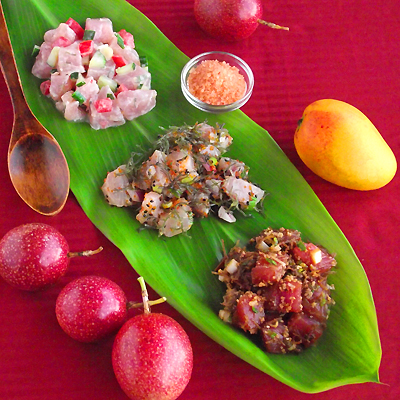
I am presenting a trio of recipes that I hope represents all these directions. This trio would make a great appetizer served in small portions either individually or as a trifecta. But while I'm here I'm serving this trio of tastes as a main course. My friends and I will enjoy this wonderful meal on the terrace while watching the sun set.

Trio of Hawaiian Style PokeTrio of Hawaiian Poke serves 4

CLICK on the following links for printable recipes of each version

Hawaiian Poke- Traditional Style Ahi

Hawaiian Poke- Wasabi Ono with Tobiko

Poisson Cru- Tahitian Style "Ceviche"

SERIOUS FUN FOOD

Greg Henry

Sippity Sup

Comments

Comment viewing options

Select your preferred way to display the comments and click "Save settings" to activate your changes.

yum!

i'm from hawaii..and i love poke! it's so easy to make too! all you need is fresh ahi and you're good. Onions,some salt, sesame oil, and kikkoman shoyu!!!! it's soo ONO (delicious)!

knicole (not verified) | Oct 4th, 2010 at 5:00 pm | Reply

Poke ME!

Wake me from this dream! I adore poke. Your creative recipes for it look amazing. Could live on the stuff. Really. xo

marla {family fresh cooking} (not verified) | Sep 9th, 2010 at 5:46 am | Reply

Love Hawaii

I was stationed there 6 months out of the year for three years when I was in the Marines, fell in love with the place, the culture and the food!

Fight the Fat Foodie (not verified) | Sep 7th, 2010 at 8:40 pm | Reply

I'm totally loving your

I'm totally loving your hawaiian posts. Makes me want to go there even more now.

Jenn (not verified) | Sep 7th, 2010 at 3:15 pm | Reply

Poke!

I've always wanted to visit Hawaii, as I've heard there is a strong organic movement there. And seeing your recent posts make me want to go even more. Fresh fish is such a wonderful thing, and your Poke sounds (and looks) exquisite.
p.s. I was in South Florida the other day, and I picked a few mangoes that looked exactly like the one in your pic-they tasted like candy too (smile)!

Stella (not verified) | Sep 7th, 2010 at 10:35 am | Reply

I am nuts for Ono, so number

I am nuts for Ono, so number 2 looks extra yummy to me. Now you've got me craving sushi. Which works out, because I'm back in LA now, and a ten minute drive away from Take-san.

But what are those seductive looking fruits to the left of the photo?

Angela (not verified) | Sep 7th, 2010 at 10:29 am | Reply

lilikoi

There are passion fruit known here as lilikoi!

jgreghenry | Sep 7th, 2010 at 10:57 am | Reply

Always fascinating!

Wow! I absolutely adore raw fish and these are like no fish tartare I've ever had! Absolutely flavorful and luscious! This is definitely a main course in my house!

Jamie (not verified) | Sep 7th, 2010 at 3:49 am | Reply

Oh, I LOVE LOVE LOVE poke and

Oh, I LOVE LOVE LOVE poke and I can tell that I am going to be in heaven with these recipes. Thank you so much for sharing.

OysterCulture (not verified) | Sep 6th, 2010 at 7:23 pm | Reply

Oooh Yum!

I love raw fish and these recipes are magnificent. You are so lucky to be eating them in such a beautiful and romantic setting. I hope you're having a great time.

Lynne @ CookandBeMerry (not verified) | Sep 6th, 2010 at 5:56 pm | Reply

What a beautiful serving! No

What a beautiful serving! No way I could choose. I'd need all 3 and I'd be happy to call it dinner.

Joan Nova (not verified) | Sep 6th, 2010 at 5:41 pm | Reply

Post new comment

The content of this field is kept private and will not be shown publicly.
  • Web page addresses and e-mail addresses turn into links automatically.
  • Allowed HTML tags: <a><p><em> <strong><ul> <ol> <li><br />
  • Lines and paragraphs break automatically.

More information about formatting options

By submitting this form, you accept the Mollom privacy policy.