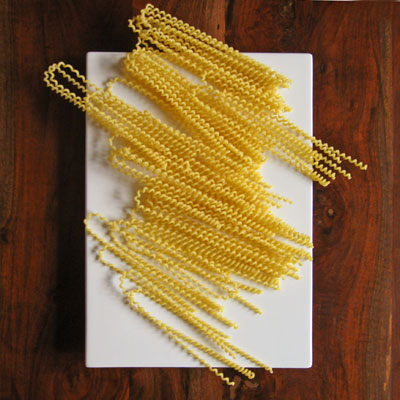
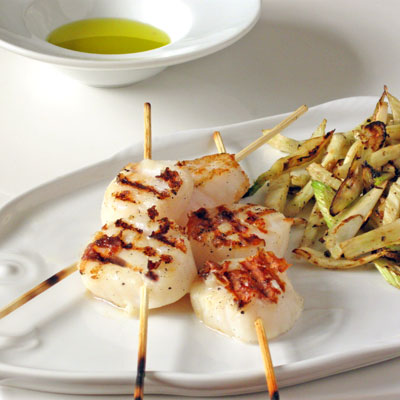
I got quite a few direct emails asking me where I got the fusilli I used in yesterday’s Grilled Scallops with Fennel and Fresh Herb Fusilli.
Well, I got it at the Hollywood Farmers Market. We have an occasional vendor there that sells all sorts of handmade pastas both fresh and dried.
So for this weeks Market Matters I thought I would pass along a little bit about pasta.
Pasta was originally a Southern Italian dish. Particularly Sicilian. Eventually the cultivation of wheat moved into other areas of the country, and pasta became a common food item all over Italy.
Northern Italian pastas are generally pastas with fresh eggs and “soft†wheat. Soft wheat is lower in protein and gluten content. Bakers tend to like flour from soft wheat for batter-based foods like cakes and biscuits. Think cake flour. The soft wheat and egg produces pasta that has a silky texture. These pastas are often prepared as stuffed pastas (like ravioli) and in Italy they are called Pasta Fresca.

The South specializes in dried durum wheat semolina pasta. These are made with out egg and are typically dried, and are called Pasta Secca. They use the “hard†high gluten durum wheat because it allows the pasta to hold its sometimes-intricate shape better. Of which there are approximately 3500 different shapes.
The durum also helps the pasta maintain an al dente consistency in cooking. Which refers to the amount of “bite†the noodle has retained after cooking. Proper al dente is the point where the pasta is tender, but still chewy.
I prefer dried pasta to fresh pasta 9 out of 10 times. Fresh pasta has its place in our world. So please do not misunderstand me. Put the pens down and step away from the keyboard. I don’t need another server crash on my email account. Because all I am saying is the difference between dried and fresh pasta is pretty substantial. You can’t feel threatened by that. Can you?
There are three basic categories for Pasta Secca:
Pasta Corta- These are the short shapes and range from the very tiny orzo to the very familiar like penne and farfalle. They are often hollow so that they cook very evenly.
Pasta Lunga- these are the long (over 4 inches) ribbon noodles like spaghetti, fettuccine and tagliatelle.
Pasta All’Uovo Secca- These are the less common dried pasta that actually contain egg. They can only be made by a machine due to the tough nature of the dough. Their shapes can vary and they are often sold in spun nest shaped bundles.
The two basic categories of Pasta Fresca are:
Pasta Fresca All’Uovo- This is made from eggs and soft wheat flour. This is mostly eaten in the north of Italy and is easily molded into shapes like tortellini and cappelletti. Though rolled out sheets for lasagna, ravioli and fettuccini are also common.
Pasta di Semola Fresca- This is Southern Italy’s answer to a fresh pasta but it contains no eggs, and it made with the hard durum wheat semolina. It’s commonly used in some rustic shapes like orecchette and strozzapretti.
However, most US markets have a much more basic selection and can easily be divided into the fresh (egg and soft wheat 00 flour). And dried (durum wheat semolina).
Which is a shame. Because pasta made for the American market can be very disappointing. Especially the dried pastas. That’s because pasta made in this country or made else where for consumption in this country contain riboflavin or thiamine. Check the label. You will see what I mean. I have no idea why these are added. Because in my opinion all they do is make it that much harder to achieve al dente perfection.
It’s hard to find very good Italian pastas even in the very best markets. You can pick up a package that says made in Italy and think you are getting the real deal. Authentic Italian pasta should contain hard wheat and water. The very best ones have nothing else at all in them. That made in Italy pasta you just picked up in Whole Foods was very likely made in Italy for an American consumer and will contain additives. Just check the label if you don’t believe me.
That does not mean you can’t get good pasta in the United States. Good Italian markets or gourmet specialty shops will carry brands like DeLallo, Latini, Rustichella d’Abruzzo, Maestri and La Molisana.
These brands are quite a bit more expensive (of course) than the grocery store varieties, but it really only works out to about 50 cents a person in the long run.
 None of this means I don’t by cheaper “enriched†dried pastas. I do. Regularly. I like DeCecco and Barilla quite a bit. But sometimes you want to splurge and enjoy that special bite that can only come from the very best. So it’s good to arm yourself with the knowledge and understand what you are buying and what the differences are.
Sometimes I even go for the super splurge, and buy handmade pasta from the vendor at the Hollywood Farmers Market. I always buy the long curly noodle in the top photo. She calls it fusilli. If that is the correct Italian name I cannot say. All the fusilli I have ever seen fall into the short Pasta Corta category.
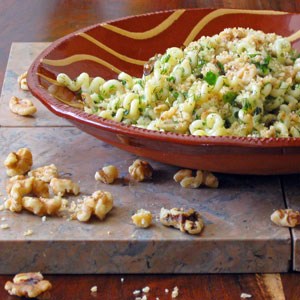
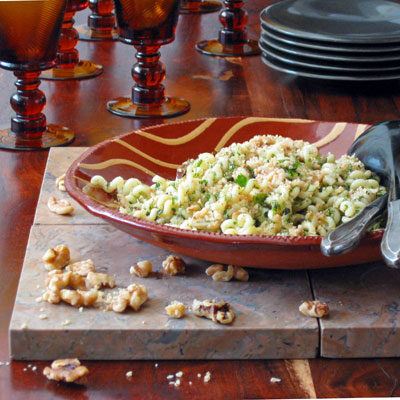
So when you have an ingredient with as much integrity as this beautiful handmade pasta you may want to keep it simple. I do. That’s why I am making a spare but classic Walnut Pasta di Campania. Truly a simple bit of pasta perfection. I am using my Hollywood Farmers Market fusilli, but tagliatelle is traditional.
Serves 4
- 2 cups shelled walnuts
- 1 cup chopped parsley leaves only
- 1/4‑cup butter, room temperature
- 3/4‑cup olive oil
- 2 garlic cloves, minced
- 1/2 cup Parmesan, grated
- 1/4‑cup heavy cream
- Salt and pepper
- 1‑pound pasta lunga
In a dry skillet set over medium high heat toast the walnut for two or three minutes, stirring often. They should be slightly browned and fragrant. Let the cool for 5 minutes before proceeding.
Put the walnuts into a food processor with the parsley leaves and pulse until a fine texture is achieved.
Add the butter, and pulse a few more times to mix somewhat.
Turn the machine on again and gradually add the olive oil in a steady stream with the blade turning continuously. Once a thick and creamy fully emulsified mixture is achieved turn off the machine and adds the garlic, Parmesan, cream and a pinch each of salt and pepper. Pulse the mixture several more times to mix thoroughly.
Cook the pasta in a large pot of boiling water and salted water until al dente. Drain and toss the pasta with the walnut sauce. Serve immediately with additional cheese for sprinkling.
SERIOUS FUN FOOD
Greg Henry
SippitySup
This is about the 4th time I have come back to read this. I guess i am trying to memorize it! But I finally noticed that this is written by Grant not Greg. That is so cool that as brothers you are doing this together. This is one of the best food and wine reads on the internet. Congratulations. Joe P.
A nice selection, thank you… some of my personal Summer wine favorites from around the Med would also include:
Retsina, with it’s traditional Aleppo pine resin aroma and overtone is wonderful chilled almost to the point of freezing… Cividin, a rather obscure sweet and highly perfumed dessert wine from north-east Italy (possibly a cross-border volunteer from modern Slovenia), is great as an aperitif or as a foil to salty cheeses… another great dessert style Summer wine in the passito style (made from raisins to concentrate the flavor) would be Colli Orientali del Friuli Picolit… and of course Saint-Joseph from the northern Rhône valley, whose young fruity content stands up to chilling, is a fantastic accompaniment to risotto al funghi…!
Thanks for your comments. I totally agree with your suggestions. I do love the fresh, fruity style of most Saint-Joseph wines. I’ll have to take your word for the Picolit wine, because I’ve only read about them but never tried any. And I’ve never heard of Cividin, so it looks like I have some work to do. Retsina, however, seems to be one of those wines you either love or hate. I fall into the latter category, but I’ll give one another go soon.
I feel so uneducated and unrefined, I have never even heard of most of these!
This is a great summer wine selection Greg. I’m missing those wonderful roses from Provence. A lot of the rose wine in the states is too sweet and resembles white zin. Really cool glass floating in the pool too.
Sam
Ok.….I give up, how’d you do the picture with the wine glass? It looks submerged in a shallow outdoor pool in late afternoon but it seems like it would be buoyant and tip over.
It was floating in the pool all on its own. The stem acted like a rudder and all was fine. There are no tricks or photoshop even. GREG
I am sipping some rose as I write this and, yes, even if the weather hereabouts doesn’t quite say summer, the wine certainly does. Drinking seasonally is a worthy goal and I will drink to that 🙂
This is just a great guide for summer wines. I cannot tell you how often I go into the wine shop wanting to get answers just this simple and then make the rest of the choices myself. The geeks who work at my wine shop always want to either ignore you or push into a specific bottle. Their first question is always. How much do you want to spend? Which is a just plain an insulting and limiting question. Sorry to rant. But I had the worst experience just last night when I asked the woman at the wine shop for a burger wine. Her answer was beer and then she and her co-worker laughed! I walked out. This information is well timed. You should make it available in a pdf so I can print it out. Joe P.
I appreciate your comments! I also believe that style, varietal and geography are far more important than price or producer when making wine choices.
great selection of wines for the summer!
We’ve been alternating between cocktails and wine recently, and enjoying every sip. Now that I think about it, we really haven’t had any rosés this summer although last year, we were awash. Thank you for this primer; of your ‘other wines of note’, Txakoli and Arneis are new! Hope we can find a bottle or two to try.
Getting a lot of buzz lately, Txokoli is a light, crisp, sometimes fizzy white wine from the Basque region of Spain. They are a little difficult to find, however. Enjoy!
How do you pronounce it? I have a BBQ tomorrow and may p/u a few of these wines to bring. GREG
Txokoli is pronounced CHOC-a-lee.
Great suggestions for summer wines. I might just have a healthy enough tummy to stomach some wine this weekend — maybe I’ll indulge!
As for that first pic, is that wine glass in the pool? Such interesting colors! It took me a bit just to figure out that the glass was in water. Really cool.
That is a glass floating in the pool with reflections of leaves and sunset…GREG
These are some lovely photos and fine suggestions for summer sippers. It’s been mostly rain around these parts. Perhaps, I should drink some of these selections to woo the sun?