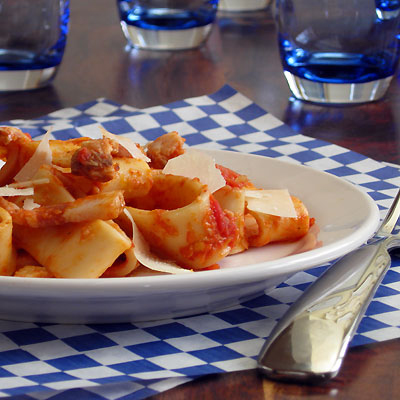
Guanciale (“gwan-chi-ah-lay”) all’Amatriciana is a cut of Italian cured pork. But please don’t call it bacon, unless you preface it with the term “magic”! It is a specialty of central Italy, particularly Umbria and Lazio. While bacon and its Italian counterpart pancetta are made from pork belly, guanciale is cut from the pork jowl. It is typically used in pasta sauces because the fat in it has a different quality than that found in other parts of the pig. You will find that it melts easily into dishes as it cooks. This is why I often refer to guanciale as “magic bacon”, because as the collagen breaks down it incorporates itself into the sauce making it silky smooth and super sweet.
Because it’s mostly fat, guanciale has a more seductive porkiness to it than the cured meats coming from the belly. Though cuts of bacon and pancetta are often substituted for guanciale the flavor isn’t the same. Because unlike pancetta or bacon, guanciale takes its flavor not from smoke but from salt, wine, herbs, and chilies.
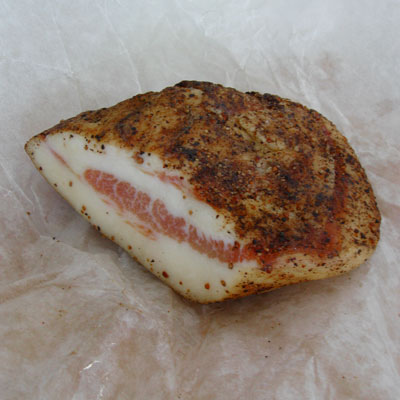 Like truffles, saffron, and Tang, guanciale is one of those elemental ingredients for which there no acceptable substitute. Though in the Zuni Café Cookbook, Judy Rodgers suggests blanching slab bacon, which mellows the strong flavor and changes the quality of the fat. Now, I love Judy Rodgers and consider her a genius. But to my palate, this method does not even come close to approximating the sweet flavor and luscious texture of true guanciale. But I understand her offering this process up to her readers because guanciale has been hard to find. That thank goodness is changing because it can now be found at La Quercia, Buon Italia, and Salumi Artisan Cured Meats.
And even though it is getting easier to find here in the U.S. guanciale goes unmentioned in most of the classic books of Italian cuisine. Waverly Root and Elizabeth David ignored it. Even Marcella Hazan’s The Classic Italian Cook Book lacks even a single recipe honoring guanciale.
This is partly due to the fact that even in Italy many people are not commonly acquainted with guanciale. That’s because traditional Italian cuisine is extremely regional. Guanciale is an example of a regional specialty. The best-known locale for its production is the town of Amatrice, in the region of Lazio near Abruzzi.
Made in the traditional method butchers there carefully cut and trim the pig jowls into the locally characteristic triangular shape. It is then salted for four or five days, washed and dried. At this point, it is seasoned with salt, coarse black pepper, herbs and dried chilies. It is allowed to cure on oak for one month. Then the jowl is moved out into the open air for two or three months while it acquires it’s distinctive smoky and slightly spicy flavor.
Guanciale is the essential ingredient in four well-known dishes regional to Lazio. Spaghetti alla Carbonara, Pasta alla Grícia, Spaghetti alla Carrettiera and the one I am featuring here today: Pasta all’Amatriciana, which simply means pasta in the style of the aforementioned Amatrice.
I first had this all’Amatriciana dish in Los Angeles at Angelini Osteria, maybe 10 years ago. There it was served with fat little tubes of pasta called bombolotti. Soon after my initial swoon, this dish was featured in the LA Times as one of the best restaurant dishes of that year. They printed the recipe in the paper. I tore that recipe out and saved it for years. But it seems I have since lost it. I have scoured the Internet but cannot find that version anywhere.
Which leaves me with a conundrum. The version I present here may or may not be the version I clipped out of the paper all those years ago. Fortunately, I did type the recipe into my recipe files, but I am a chronic tinkerer when it comes to recipes. I honestly can’t remember if these words and directions were altered by me or are original to Gino Angelini. Either way, this is the basis of the recipe I use and love. It’s one of those recipes that can easily be adjusted to your tastes and pantry, as long as you have the basic components you can certainly give it your own spin.
So I suggest you get your hands on some magic bacon and make this for yourself. You really won’t believe how a few simple ingredients can come together in such a magical way.
Pasta all’Amatriciana with Guanciale serves 4 CLICK here for a printable recipe
- 1 lb bombolotti pasta, 1/2 sized rigatoni or you choice
- 1⁄2 lb guanciale
- 2 T extra-virgin olive oil
- 2 clv garlic, peeled and halved lengthwise
- 1/4 c onion, finely chopped
- 4 medium Roma tomatoes, peeled, seeded and chopped
- 1⁄2 t red pepper flakes
- 2 T Parmigiano-Reggiano, grated
- 2 T pecorino-romano, grated, plus more for garnish
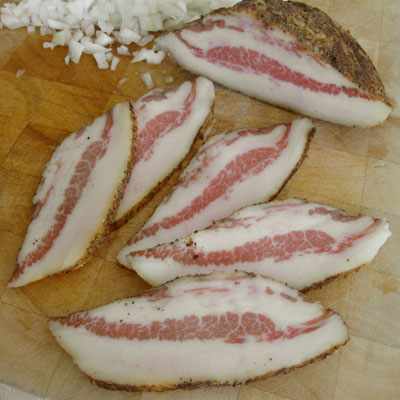 Boil water for pasta. Add salt to the water after it has heated to avoid salts leeching into your cookware. Add pasta to boiling water. Cook until al dente, approximately 10 mins, if you use bombolotti.
Meanwhile cut the guanciale into strips about 1 inch long and 1/4 inch thick.
Heat large skillet over medium-high heat. Add one tablespoon oil. Add the garlic clove and cook until fragrant, 1 min. Add guanciale and cook lightly until browned (It will not cook up like bacon). Add the onion and cook another minute or so. You may need to spoon off some of the fat, but leave plenty enough so the sweet pork flavor infuses the sauce and makes it sweet and silky. Add the tomatoes and cook another 2 mins. Add salt to taste and the red pepper flakes. Discard the garlic.
Drain the pasta and add it to the skillet. Add the Parmigiano-Reggiano and the pecorino-Romano. Add the remaining tablespoon of oil and toss together. Serve hot, family style with more pecorino at the table.
SERIOUS FUN FOOD
Greg Henry
SippitySup
thanks, maybe a bit late, but here you go! :http://recipes.latimes.com/recipe-bombolotti-all-amatriciana/
Wow. Thanks. GREG
Thanks for the post. I have a mess of green garlic and sorrel in my garden, and am anxious to make this.
I did not have green garlic until I moved to California and if I had known what I was in for, I’d have moved a heck of a lot sooner! I love green garlic — it is so versatile and doesn’t get overwhelming like the mature stuff can. Your soup recipe sounds just awesome!
salut greg tu as de la chance d’avoir un tel professeur : l’ail nouveau arrive sur les marchés en france ! ta recette est super !! Ciao Pierre de Paris
Oui, Alice Waters est le meilleur professeur et l’ail nouveau est tres bon! GREG
I might have to plant garlic just to make sure I have the opportunity to try green garlic and especially this soup. What a beautiful spring bowl.
3 years ago I found 4 stalks; last year I found several bunches, several times; This year I’m buying it by the armload. I first had it with very soft scrambled eggs — the green garlic just warmed in butter first (and lots of it). Never thought of soup… Looks delicious!
Now there is a big bunch of spring in a bowl!
An excellent soup! Last year my supermarket had all kinds of things like green garlic and ramps and fiddlehead ferns but not this season yet 🙁 I need to talk to customer service this weekend!
…a partial head had fallen behind out of sight behind a pair of crocks and sat there for a while 😉
I love the more rustic approach to this with the unskinned potatoes, Greg. Then again I like almost everything you create. Quit being so awesome, dammit.
I don’t think I have ever cooked with green garlic. Now I’m ashamed! And I need that book.
I need to check out Alice Waters book, that soup sounds really good and it makes the perfect spring time soup too
I had green garlic for the first time last year and made a nice pesto out of it, but I think the flavor of it definitely shines more in this soup than it did in my pesto…(basil can be kind of overpowering). I will definitely have to try it again in something like this. See what it REALLY tastes like.
This is a beautiful, unadulterated dish. I completely agree that Alice Waters’ book is brilliant.
…in so many ways. I don’t believe that I’ve ever had green garlic (but your description makes me want to) and sorrel, though I use it rarely, is a real taste of my childhood — I used to pick it wild from the fields and eat the leaves (though it was only years later that I found out that what I had been eating was called sorrel). As for potatoes, well, ’nuff said.
gosh greg i’ve never had raw green garlic before, isn’t that weird. but now i want to try it. i bet this soup would be so good for the blood. (raw garlic is very good for the blood, cleaning, etc..)
I loved your post and am glad you put in the recipe for this soup. I just wrote about Bill Maher and Chef Alice Waters on my blog, about five days ago. She is so lovely.
I’m going to start looking for some green garlic at my farmers market! This soup sounds wonderful!