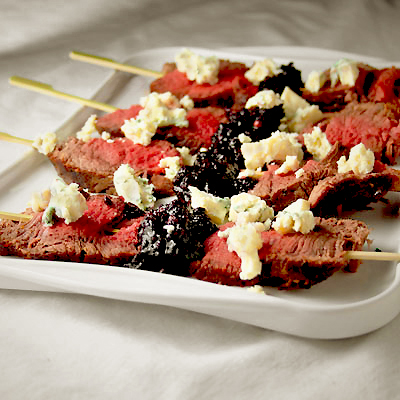
Today we get to the “meat of the matter” in this week long series of small plates with wine pairings. Beef Tenderloin Skewers with Cranberry Port Peppercorn Relish & Gorgonzola which we paired with Hall Napa Valley Cabernet Sauvignon, 2007.
It’s a simple dish with a lot of bold flavor. The relish has the bite of plenty of assorted peppercorns and the Gorgonzola is just the right finishing touch. A Cabernet such as this Hall is a perfect compliment.
But since a new year is starting we also thought we’d also start something new. Wine Reviews!
Now we’ll still do wine pairings. That’s what Sippity Sup is all about. But my brother Grant will also be reviewing some of the wines that cross his path as well. He has developed a Sippity Sup appropriate rating system that is far less complicated than points or stars, because it relies on common sense and the simple question, would I reccommend this wine to a friend? It’s basically a scale from Nope! to Hell Yes! in four easily understood categories. CLICK here for an explanation of Sippity Sup’s wine rating system.
The first wine he has chosen to review is paired with my beef tenderloin skewers and is a part of my small plates series. Read his review of this wine after the jump or CLICK here for a printable recipe serves 4 Beef Tenderloin Skewers with Cranberry Port Peppercorn Relish & Gorgonzola. GREG
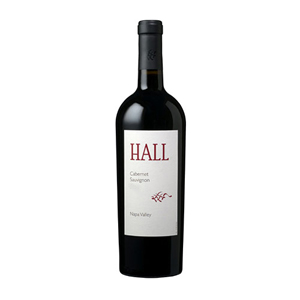 Hall Napa Valley Cabernet Sauvignon, 2007
As the self-professed “wine guy” at Sippity Sup, I’d say that I take wine pretty seriously.
But wait a minute, I take that back, because I’m also the guy who is always telling my friends and customers that wine is fun, and the biggest mistake one can make is to take it too seriously. In fact, I actually have “fun” with those who treat buying a bottle of wine like they’re researching a cure for cancer, or appointing a Supreme Court Justice. Part of this “fun” includes keeping a list of some of the most outrageous, pompous, and ill-informed comments I’ve overheard at wine tastings, coming from both sides of the pour-spout. But that’s a subject for another post.
What I do take a little more seriously, however, is trying to understand how I perceive the wines I am tasting, and what is driving my perceptions, and ultimately, my opinions of those wines. So here, I’ll be the first to admit that I do “nerd-out” a little. I keep tasting notes on many of the wines I taste, where I consider such elements as aroma, flavor intensity, sweetness, acidity, tannin, oak, weight and complexity. I do find each of those elements “elementary” when assessing wine, and I think my training and education has prepared me well for this type of analysis. Yet I can’t help but wonder about other factors that come into play; whether real or imagined.
Which brings us to the Hall Napa Cab– finally! I recently received 2 bottles of the Hall Napa Valley Cabernet 2007 from the winery in the mail as samples. I was eager to taste the wine, because I have enjoyed wInes from the Hall Winery in the past, and I am aware of the high ratings and good press their wines have received. But now I’m worried … will these factors affect my perception of the wine? I’m fully aware that their 2006 Napa Cabernet was rated 94 points, and placed #18 on Wine Spectator’s “Top 100” Wines of 2010. I also know that their 2006 “Kathryn Hall” Cab was one of the best Napa Cabs I’ve tasted in several years, and scored a 96! So finally I decided to do what I’ve been telling others for a long time, which is forget about all that ratings stuff and just drink the wine! So I did.
This is a deep-red colored wine, with intense aromas of ripe blackberry, tart raspberry, baking spices and touch of Starbuck’s mocha-latte. The flavors are rich, and complex with blackberry compote, cassis, licorice, and more chocolate. Of course, Cabernet is a no-brainer with beef, but this wine in particular pairs well with Greg’s Tenderloin Skewers. The tart-fruit component is great with the cranberry relish, the minerality picks up on the earthiness of Gorgonzola cheese, and the wine’s bright acidity not found in many Napa Cabs, keeps the wine from overpowering the more delicate beef flavors found in tenderloin. And it’s not straight Cab. Happily the winemaker has blended in Merlot, Petit Verdot and Cab Franc to add an elegance not usually found in Cabernet alone.
If asked to recommend this wine, my answer is a firm Hell Yes! in the pseudo-Mickey-Mouse-quasi wine rating system I’ve come up with. CLICK here for an explanation of Sippity Sup’s wine rating system.
At Around $40, this is really an outstanding example of Napa Valley Cabernet. And this is a wine built to age, so it will evolve and improve over the next 5–10 years. I have to make sure I remember to come back and taste this wine again in 5 years. I’ll just need to forget how much I loved it, so I don’t screw up my “perceptions.”
 SERIOUS FUN FOOD
Grant Henry
SippitySup
Scallions in cheese sauce is yummy magic.
out of control with this dish, it sounds perfect and oh-so decadent. Just reading the recipe made me loosen my belt a notch! — S
Oh this is the ultimate mac and cheese — a very sexy adult version if you ask me — and where were you on my birthday?
You did it Greg!! Your Lobster Mac and Cheese! I like the different cheeses you’ve used in this and the cavatappi pasta (I’ll have to look for that!). I’ve been wanting to make a Lobster Mac…I’m going to give your recipe a try instead of the one I was going to use(from Saveur).
You are so on point with all of this! The perfect comfort food following all that holiday cooking. And I’m with you…I make the white sauce and add ‘too much cheese’ and it always comes out perfect. I usually make lot just so I can freeze a casserole for my later “comfort” too.
Oh goodness… this is definitely a “once a year” kinda dish but if you are going to do “mac and cheese” — go big or go home.. and boy did you go “big” — this is truly over the top!!!
An amazingly decadent makeover of mac & cheese! So rich and satisfying with mascarpone and fontina, excellent!
I actually suggested lobster mac n cheese last week to my husband (made with about 3 different cheeses ) and he just shrugged. I may just have to make it anyway…more for me 🙂
…from the spaghetti squash. You’re an equal opportunity blogger.
Hi Greg — your recipe is a great addition to the mac & cheese party. Adding mascarpone — excellent idea.
LL
I can’t eat Mac and Cheese anymore due to my diabetes. OTOH, I’ll take the lobster, butter, mascarpone, fontina, and cheddar and go to town. Maybe I’ll sub in some foie for the scooby noodles. Ah, good times.
Now I am starving Greg. You have that effect on me. LOL
Jason,
Can’t eat pasta because you’re Diabetic? Me, too, but there is a brand of pasta out there made by Dreamfields that is Diabetic friendly and good for you AND resonably priced, considering you get what you pay for. Check them out at http://www.dreamfieldsfoods.com
Check them out and enjoy,
Marsha
Totally revved up, indeed! I haven’t eaten dinner and i want some of your luxurious lobster mac & cheese now! Great info about why you use a roux and thank god no processed cheese.
wow amazing and love the way you cooked it
Lobster, mascarpone and clam juice in mac and cheese? Too bad we’re not neighbors or you’d have an unwanted guest in your kitchen. Mac and cheese taken up several notches. Amazing!
Using the mascarpone would be a well made marriage with the lobster. To me their is nothing more comforting than macaroni and cheese in the winter months. Why not amp it up a bit!!
From side dish to main dish, you rocked this mac and cheese out, Greg. I like your combination of cheeses.
Wow! Talk about taking a humble dish and giving it an extreme make over! This sounds heavenly Greg! I love what you have done here-especially with the addition of lobster and mascarpone. Pure genius! I have bookmarked this to enjoy in our cooler months.
what if i want to cuddle up with someone i love and his name is “mac” n cheese. next to mashed potatoes mac n cheese has to be #2 on my comfort food list, but lobster now that puts it over the top. fontina is a decadent choice — you know there are rules against seafood and cheese, but rules are meant to be broken~!
I’m probably one of “those” people who have never had a blowback experience with mac and cheese because I’ve probably been doing it wrong my entire life.… but now I know I can blame it on the plethora of bad cookbooks.
Loved your thought process in making the dish — very thorough and analytical.
[K]
mac and cheese and lobster seem like such a perfect pairing-the ultimate comfort food.
This looks amazingly luxurious! Would love to give this a try. Love the addition of clam juice.